
Of the Political Stage, the Game of Politics, and the Campaign Weapon
When we speak of the “political stage“, the “game of politics“, or the “campaign weapon” (Baldauf, 1997, pp. 186f. & 214; transl. V. M.), this reveals one thing in particular: to speak of politics is to speak in metaphors. More than that: conceptual metaphors such as POLITICS IS THEATRE, POLITICS IS A GAME, or POLITICS IS WAR reveal that ambiguity is already built into the images of our language. Ambiguity is a fundamental property of language (cf. Klein & Winkler, 2010) and of images (cf. Bentwich & Gilbey, 2017). As a verbal image, the metaphor is therefore ambiguous as well.
Metaphors We Live By
But what are metaphors, actually? Metaphors we live by (Lakoff & Johnson, 1980) structure not only how we speak, but also how we think and act. They allow us to understand the abstract, rethink the familiar, and lead us to new insights (cf. Jäkel, 2002, p. 22). This is precisely what makes metaphors significant for educational processes.
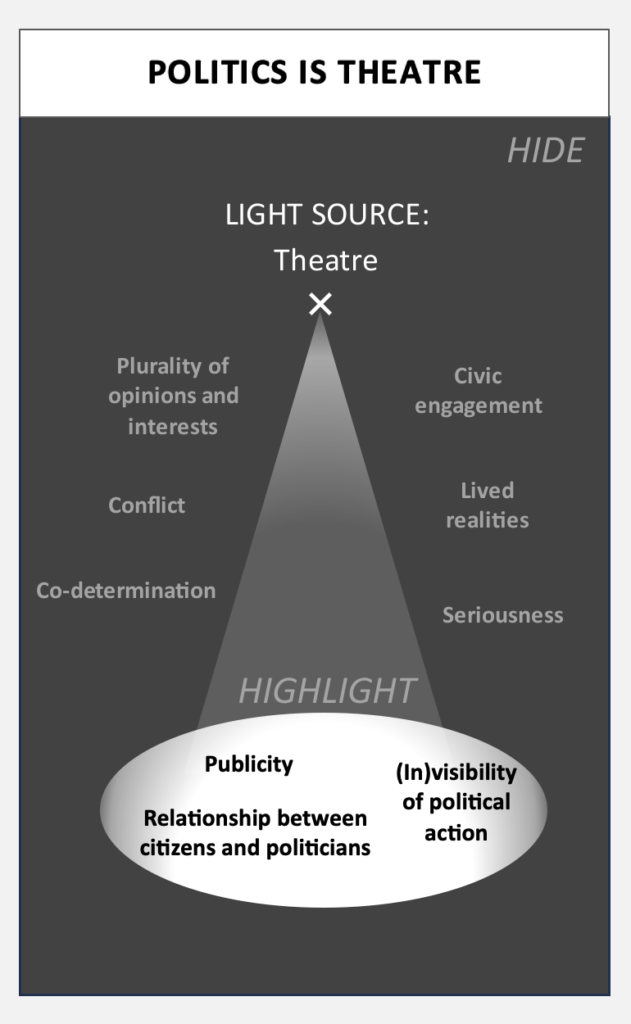
A metaphor transfers experiences from a concrete, often more familiar domain — such as theatre, game, or war — onto a complex, more abstract domain such as politics (cf. Baldauf, 1997, pp. 15ff.). In doing so, it brings certain aspects into focus while obscuring others — highlighting and hiding (Lakoff & Johnson, 1980).
To take one of these examples: POLITICS IS THEATRE brings the necessary publicity and visibility of political action into the light, while its seriousness and credibility remain in the dark.
Figure 1 makes this mechanism visible. The light in which politics appears is cast by the theatre. What lies within the beam of light is highlighted as an aspect of politics by the metaphor. Other aspects of politics, lying outside the beam of light, remain unseen in the shadow of the metaphor (cf. Männer, n. d.).
Each metaphor thus creates its own readings, while at the same time concealing what another metaphor would make visible.
Metaphors and Ambiguity
Why are metaphors ambiguous? The definition of ambiguity in the ACES framework helps answer this question:
“Ambiguity refers to a property of situations, information, or signs themselves: a situation is ambiguous when it admits of more than one legitimate interpretation, when relevant information is contradictory or incomplete, or when the categories required for orientation are themselves contested.” (Gloe & Männer, in preparation; cf. also Heindl & Gloe, 2026)
This also applies to metaphor: ambiguity refers to a property of the metaphor itself. It is ambiguous because it admits more than one legitimate interpretation, and because the metaphorical transfer itself always remains incomplete. Like an image, a metaphor can only be circumscribed, not fully described (cf. Krämer, 2003, p. 513). And, as with an image, the meaning of a metaphor only emerges in perceiving, thinking, and speaking about it — rather than being fixed within it (cf. Hoffmann, 2021, p. 177). A metaphor, then, cannot be reduced to a single reading. And it always remains only an incomplete excerpt, because it highlights certain aspects while hiding others.
On the Trail of Ambiguity: Exploring Metaphors in Class
How can this ambiguity become tangible for learners? By having them explore metaphors and their ambiguity themselves, using metaphor analysis (Schmitt, 2024). This research method can be adapted for classroom use (cf. Männer, 2024, p. 142). Students go through the research process themselves: they analyse, categorise, and interpret metaphors (abridged from Schmitt et al., 2018). In which metaphors is politics represented? Which conceptual metaphors can we compile? What do they highlight, what do they hide? And what does a comparison of different conceptual metaphors show us? These are questions students can track down for themselves. In principle, any form of text is suitable for this — newspaper articles, political speeches, social media posts. Students can even explore the metaphors of their own classroom: textbooks, teaching materials and notes, or interviews that learners conduct with one another.
Applied in class, metaphor analysis fulfils central didactic principles that foster the ability to deal with ambiguity:
- Principle of Openness and Non-Closure: Metaphor analysis requires an open research stance in class as well. Its answers are not arbitrary, but the result of the method’s rule-governed application. What remains open are the readings themselves: learners may arrive at different interpretations, placing readings side by side and comparing them rather than narrowing them down to a single one.
- Principle of Productive Irritation: Simply identifying metaphors can already be irritating in itself — for instance, when their frequency reveals just how pervasively language is permeated by metaphors. Comparing one’s own interpretation with others’ can likewise give rise to irritation, when these diverge from one’s own. The irritation becomes productive when it leads to further reflection, rather than premature rejection.
- Principle of Reflexivity: Through metaphor analysis, students can explore for themselves how metaphors shape their own knowledge, judgment, and interpretation of themselves and the world. Comparing this with other interpretations makes visible that one’s own view is only one possible view among several, and depends on the vantage point from which one looks.
(cf. Gloe & Männer, in preparation, on the didactic principles)
The Spotlights on Politics
Theatre, game, war – these three common metaphors for politics have already appeared at the outset. Placed side by side, it becomes visible how differently they illuminate the same object (see Figure 2).
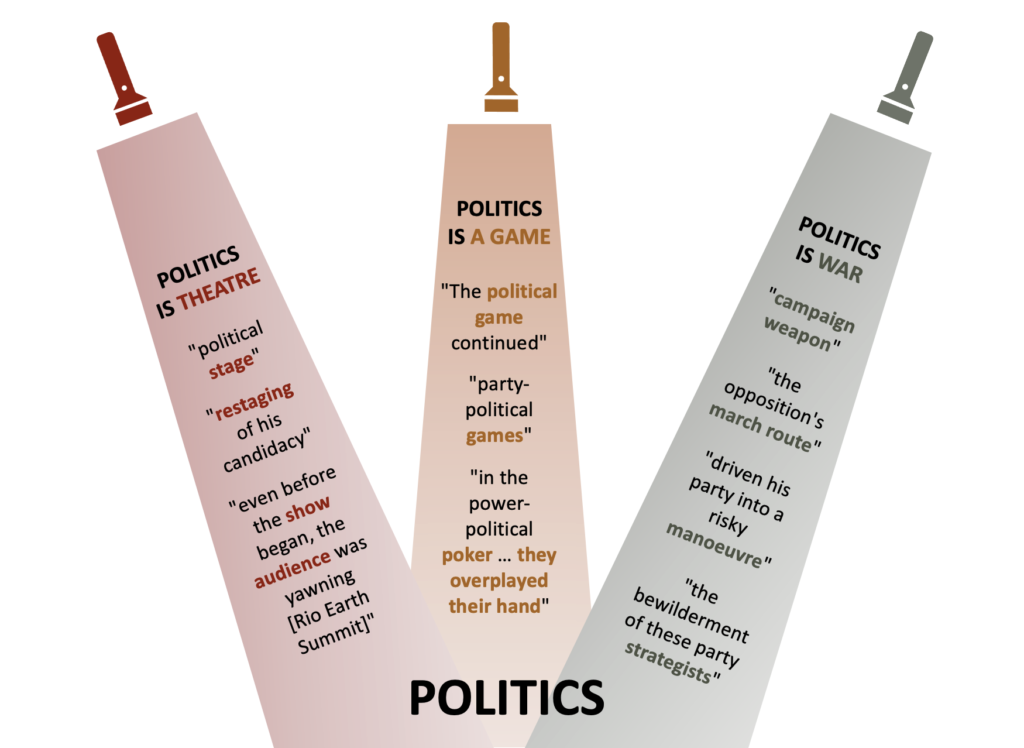
As shown, each of these three spotlights is already ambiguous in its own right: none of the metaphors fixes a single reading. Taken together, they show something more: even multiple metaphors never combine into a complete picture, and yet they are richer than the concept they open up. An abstract concept such as politics thus appears as something that eludes definiteness on several levels at once: within each individual metaphor, and in the juxtaposition of several. And yet metaphors bring light into the dark – despite, or perhaps because of, their ambiguity.
Practical Material: Templates for Working with Metaphors
Here you will find two templates for working practically with metaphors – developed in the author’s own teaching practice and tested with both pupils and university students.
References
- Baldauf, C. (1997). Metapher und Kognition: Grundlagen einer neuen Theorie der Alltagsmetapher. P. Lang.
- Bentwich, M. E., & Gilbey, P. (2017). More than visual literacy: Art and the enhancement of tolerance for ambiguity and empathy. BMC Medical Education, 17(1), 200. https://doi.org/10.1186/s12909-017-1028-7
- Gloe, M., & Männer, V. (in preparation). Ambiguity Competence for Education and Society (ACES)—Framework. https://aces-project.eu
- Heindl, F., & Gloe, M. (2026). Rethinking Democratic Citizenship Education: Ambiguity Tolerance as a Neglected Future Competence. The Asian Conference on Education 2025: Official Conference Proceedings, 1457–1467. https://doi.org/10.22492/issn.2186-5892.2026.111
- Hoffmann, K. (2021). Doppelte Bildlektüren (mindestens). Zur komplexen Vermittlung der Moderne im Kunstunterricht am Beispiel der Ausstellung museum global. Mikrogeschichten einer ex-zentrischen Moderne (2018/19). In A. Schnurr, S. Dengel, J. Hagenberg, & L. Kelch (Eds), Mehrdeutigkeit gestalten: Ambiguität und die Bildung demokratischer Haltungen in Kunst und Pädagogik (1st ed, pp. 175–192). transcript.
- Jäkel, O. (2002). Hypothesis Revisited: The Cognitive Theory of Metaphor Applied to Religious Text. Metaphorik.De, 2, 20–42.
- Klein, W., & Winkler, S. (2010). Einleitung. Zeitschrift Für Literaturwissenschaft Und Linguistik, Themenheft: Ambiguität, 40(158), 5–6.
- Krämer, S. (2003). Sagen und Zeigen. Sechs Perspektiven, in denen das Diskursive und das Ikonische in der Sprache konvergieren. Zeitschrift Für Germanistik, Neue Folge, 13(3), 509–519.
- Lakoff, G., & Johnson, M. (1980). Metaphors we live by. University of Chicago Press.
- Männer, V. (2024). Völlig losgelöst, Major Tom? Das Imaginäre der Mensch-Tier-Umwelt-Verhältnisse in Bildungsmaterialien – eine Metaphernanalyse. In Beziehungsweisen von Mensch, Tier und Umwelt. Springer VS.
- Männer, V. (o. J.). ’Ich habe, wenn ich über Demokratie nachdenke, direkt so ein Bild im Kopf’—Metaphern der Demokratie im Denken von Schüler:innen [Unpublished doctoral dissertation manuscript]. Ludwig-Maximilians-University Munich.
- Schmitt, R. (2024). Metaphor Analysis. In U. Wolfradt, L. Allolio-Näcke, & P. S. Ruppel (Eds), Cultural Psychology (pp. 219–228). Springer Fachmedien Wiesbaden. https://doi.org/10.1007/978-3-658-45155-4_22
- Schmitt, R., Schröder, J., & Pfaller, L. (2018). Systematische Metaphernanalyse. Springer VS. https://doi.org/10.1007/978-3-658-21460-9