
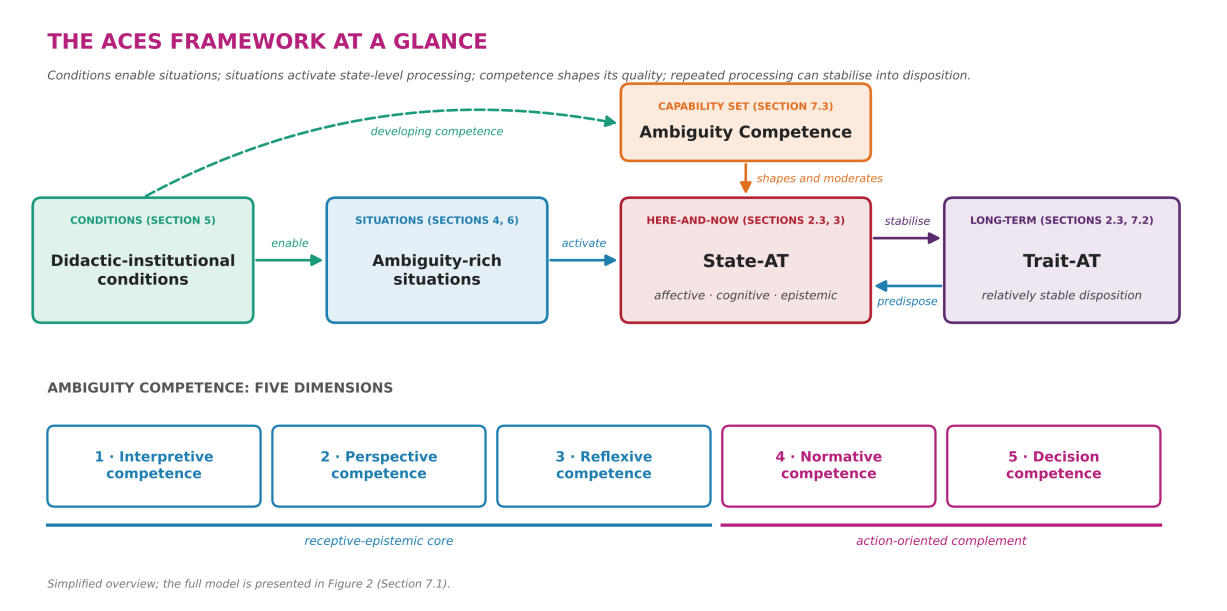
The ACES Framework presents a multi-level model of ambiguity tolerance for democratic education. It is addressed primarily to teacher educators, developers of curricula and teaching materials, and researchers in democratic and citizenship education, as well as to education policymakers and school leaders concerned with the institutional conditions of ambiguity-rich learning; for classroom practitioners, it provides the theoretical basis on which the practice-oriented ACES materials build, and it offers guiding questions and indicators for reflecting on the conditions of their own teaching (7.3.7).
The framework is structured into eight main sections. Section 1 introduces the educational challenge of ambiguity, the construct of ambiguity tolerance, and the framework’s specific contribution. Section 2 establishes the conceptual foundations – defining ambiguity, situating ambiguity tolerance as a psychological construct, distinguishing trait and state perspectives, and considering cultural variability. Section 3 examines the affective, cognitive, and epistemic mechanisms through which ambiguity is processed.
Section 4 contextualises ambiguity within social, cultural, and transnational settings. Section 5 addresses the institutional and organisational conditions under which ambiguity-rich learning becomes possible. Section 6 develops the pedagogical approaches – didactic principles, methodological approaches, and participatory learning processes – through which Ambiguity Competence is cultivated. Section 7 integrates these elements into the framework’s overall model: its core architecture, process logic, the five dimensions of Ambiguity Competence, and its application across European educational systems. Section 8 concludes.
The European dimension of the framework is not concentrated in a single section but developed cumulatively. Section 4 situates ambiguity tolerance in transnational and culturally variable contexts. Section 5 refers its institutional conditions to the assessment regimes and curricular settings of the partner systems (5.5). Section 7 develops the framework’s claim to comparative applicability and articulates its contribution to European democratic education. Read together, these sections set out the framework’s response to a question central to any transnational educational project: what can be shared, and what must remain contextsensitive, when democratic competences are cultivated across diverse European educational systems.
A note on scope: This document presents the ACES Framework in its theoretical articulation. Its relation to empirical research runs along three lines, which the document handles differently.
The first comprises conceptual sources – the theoretical and empirical-conceptual literature on which the framework’s constructs build. They range from the personality-psychological tradition of ambiguity tolerance (Budner, 1962; Frenkel-Brunswik, 1949; McLain et al., 2015) and the theory of transformative educational processes (Koller, 2016) to the systemstheoretical analysis of organisations (Kühl, 2020) and the RFCDC (Council of Europe, 2018a), and form the framework’s foundational reference base.
The second comprises focused empirical evidence – specific studies cited where they underwrite particular substantive claims, such as the studies on game-based interventions in 6.2.6 or the meta-analytic findings on feedback in 7.2 (Wisniewski et al., 2020). Empirical anchoring at this level is selective rather than comprehensive.
The third comprises adjacent research traditions – epistemic cognition, controversial issues in education, formative assessment – to which the framework’s claims are connected at specific points but which it does not systematically review. That review, together with measurement approaches, the operationalisation of state-level dynamics, and the design of intervention and longitudinal studies, belongs to the empirical companion paper: not a belated foundation for a free-standing theory, but the extension of an already empirically informed framework into the methodological registers it presupposes.
The framework presented here should therefore be read as a working theoretical model: empirically informed at the conceptual level, anchored in focused empirical evidence at substantive claim-points, and designed to enable – rather than to substitute for – systematic empirical engagement in subsequent work. It is stable enough to guide empirical work and pedagogical design, and open to refinement; adjustments will be documented in subsequent versions.